World War IV
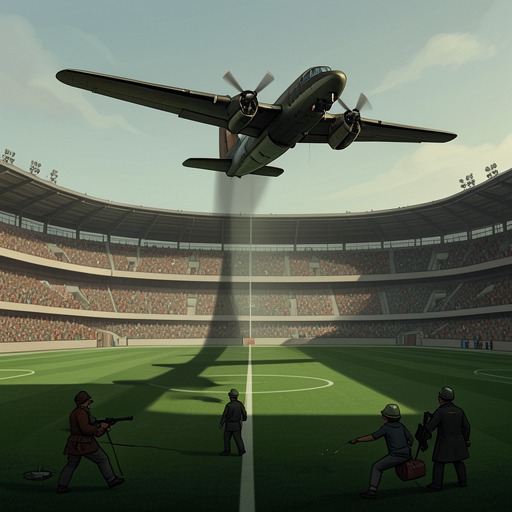
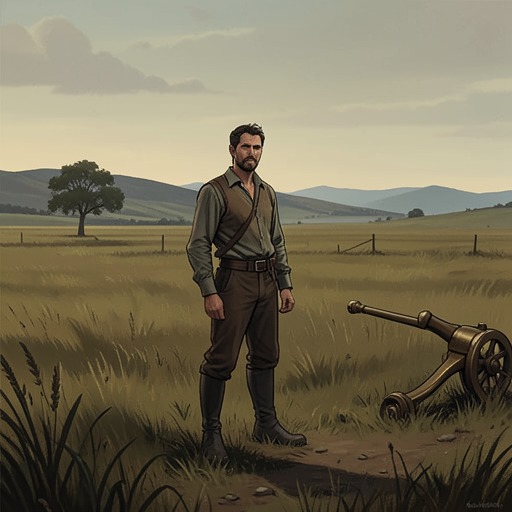
The SilenceWorld War IV is the anticipated successor to World War III in the novel’s account of a global crisis: a war in which nuclear weapons have become unusable, yet violence persists through digital and biological means. Its defining image is a return to sticks and stones, a forecast that gives technological collapse both a military meaning and a human scale. The conflict is not presented as a cleanly separate campaign; it is bound to a present in which war continues even as the systems that once organized modern life fail.
The prediction and its historical frame
Albert Einstein’s warning distinguishes between the unknown weapons of World War III and the primitive weapons of World War IV. Martin Dekker recalls this prediction while trying to make sense of the crisis around him. He associates Einstein with a theory dated 1912, which he describes as one hundred and ten years old, and with a manuscript whose ink changes from brown to black as its paper improves. The remembered scientific past stands against a present that Martin calls World War III, while the prediction turns the next war into a possible consequence of the current one.
The forecast does not specify how or when World War IV begins. Instead, it supplies a stark endpoint: after increasingly sophisticated forms of conflict, people may be left fighting with the simplest weapons. The image is not treated as reassurance that advanced warfare has ended. In the novel, the disabling of nuclear arms does not end the war; it shifts the danger into other systems and forms of attack.
A war that continues without nuclear weapons
The narrative describes launch codes being manipulated remotely by unknown groups or agencies, leaving nuclear weapons worldwide dysfunctional. Missiles do not cross oceans, and bombs are not dropped from supersonic aircraft. That absence of familiar nuclear strikes is paired with the explicit insistence that the war rolls on: cyberattacks, digital intrusions, and biological aggression accumulate, bringing anthrax, smallpox, other pathogens, death, disability, starvation, and plague into the account of conflict.
The change is also political. Countries once presented as fervent proponents of nuclear arms now speak in the language of living weapons. Martin’s compressed inventory—germs, genes, spores, powders—makes the new threat less like a single weapon arriving from a visible distance and more like danger lodged in biological material. The contrast with sticks and stones is therefore not a simple opposition between high technology and its disappearance. The novel first shows advanced systems being turned against populations or rendered unreliable; the forecast of primitive weapons names what might remain after that order has broken down.
Collapse and the loss of ordinary measures
The war’s damage extends beyond weapons. Power grids collapse, and the surrounding account raises the prospect of rising oceans and rapidly warming air alongside death and disease. These developments make the conflict difficult to contain within the conventional image of a battlefield: infrastructure, bodies, and the conditions of life all become part of its reach. The prediction of a future fought with stones acquires force in a world where the systems that sustain technological civilization are already failing.
The novel connects this systemic failure to ordinary habits of measurement. At the beginning of the journey, a passenger follows words, sentences, numbers, and distance to destination on a screen; the display gives an arrival time of 16:32, a speed of 471 miles per hour, and three hours and thirty-four minutes remaining. During severe turbulence, the screen goes blank. The change from quantified progress to an unreadable display provides a concrete counterpart to the larger disruption: familiar instruments no longer guarantee orientation or control.
Time, recollection, and the war’s meaning
The characters’ sense of time becomes as unstable as their technical surroundings. In the living room, time seems to have jumped forward, and the characters wonder whether something at midnight intensified the disruption. Diane Lucas reflects on impaired orientation, lost curiosity, and the physics of time; her thoughts move between teaching, the classroom, and the crisis outside. These reflections make time more than a backdrop to World War III: the ability to place events in sequence, and to understand how the present arrived, is itself under strain.
Jim Kripps recounts the aircraft’s emergency landing only after the immediate aftermath—the van, the clinic, and the treatment of his head. He remembers the plane jolting and banging, the pilot speaking French, the hard landing and skidding, his head striking the window, blood running into his eye, and his hand reaching for Tessa Berens. Although the crash happened only hours earlier, he says it seems a dozen years ago and questions whether some details belong to the event or to his later rambling. This delayed, uncertain recollection gives the crisis a subjective duration that no flight display could measure.
World War IV thus functions as both a prediction about the future of warfare and a lens on a present already losing its assurances. Nuclear paralysis has not brought peace; digital and biological threats continue while power and orientation falter. Against that escalation, the image of sticks and stones is at once a forecast of technological ruin and a reminder that the collapse of systems does not end human conflict.